
Wearable devices (WDs) are revolutionizing patient monitoring in intensive care units (ICUs). Initially designed for fitness, these devices now provide continuous, non-invasive tracking of vital signs such as heart rate, respiratory rate, blood pressure, and glucose levels.
The advantages of WDs in the ICU are significant. They reduce the need for invasive monitoring, enhance patient comfort and mobility, and facilitate transitions from high-intensity ICU care to standard wards. Additionally, WDs support the early detection of complications like delirium and help prevent hospital-acquired pressure injuries.
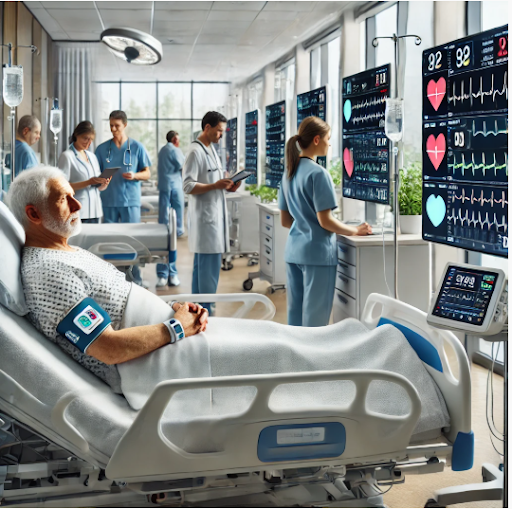
Understanding Wearable Devices in ICU Settings Wearable devices are lightweight, portable technologies designed to be worn on the body, capable of tracking vital physiological parameters. Originally developed for fitness applications, WDs are now being used to monitor heart rate, respiratory rate, blood pressure, glucose levels, and even patient posture and movement within critical care environments. Their ability to provide real-time data makes them invaluable in bridging the gap between ICUs and standard hospital wards.
Economic Impact:
- Cost-Effectiveness: Studies suggest that wearable technologies can enhance quality-adjusted life years and may be cost-effective or even cost-saving.
- Reduction in ICU Transfers: Implementing remote monitoring systems, such as Masimo’s Patient SafetyNet, has led to a 48% decrease in patient transfers to ICUs, resulting in significant cost savings.
- Decreased Rapid Response Team Calls: Utilizing wearable monitors has been associated with fewer rapid response team calls, highlighting potential improvements in patient management and resource utilization. ScienceDirect
Social Impact:
- Enhanced Patient Comfort and Mobility: Wearable devices reduce the need for invasive monitoring, leading to increased patient satisfaction and mobility. Lippincott Journals
- Continuous Monitoring in Resource-Limited Settings: In low- and middle-income countries, wearable devices have demonstrated feasibility in recording high-quality continuous vital sign data, improving patient care in resource-constrained ICUs. BMJ Innovations
- Promotion of Health Equity: Medical wearables have the potential to bridge healthcare gaps by providing continuous monitoring, especially in vulnerable populations, thereby promoting health equity.
Case Studies
- Real-World Implementation in ICUs: A study examined the use of wrist-worn accelerometers in an ICU setting, combining movement data and clinical features to predict patient acuity. The results demonstrated that these devices could successfully identify stable versus unstable patients, showcasing their potential utility in managing patient care more effectively.
- Cost-Effectiveness of Wearable Devices: A case study on a low-cost wearable device used for perioperative risk stratification illustrated how financial barriers could be overcome. The device, priced below 80 euros, showed significant results, suggesting that accessible technology can facilitate extensive monitoring without straining hospital budgets.
- Patient Outcomes Improvement: In a cohort study, the introduction of non-invasive wearable patches for continuous monitoring yielded results comparable to traditional ICU monitoring systems. This highlighted their reliability and potential for reducing the incidence of false alarms, ultimately leading to better patient outcomes.
Key Market Drivers for Wearable Adoption in ICUs
- Non-Invasive Monitoring: Patients benefit from reduced discomfort, especially post-surgery or during recovery, by avoiding invasive procedures.
- Resource Optimization: WDs enable comprehensive monitoring in low-resource settings where high nurse-to-patient ratios and equipment are limited.
- Technological Integration: The growing interoperability with hospital information systems (HIS) and electronic health records (EHR) facilitates seamless data sharing.
Cost-Effectiveness: Reducing the need for complex setups and disposables helps hospitals manage operational expenses better.

Emerging Applications of Wearable Devices in Critical Care
- Cardiac Monitoring: Devices utilizing ECG, PPG, and SCG technologies detect heart rate variability and cardiac anomalies.
- Respiratory Monitoring: Advanced sensors track respiratory rates and tidal volumes, with potential applications in post-operative care and chronic disease management.
- Blood Pressure Monitoring: Cuffless solutions are gaining traction, offering continuous blood pressure readings through pulse transit time (PTT) and pulse arrival time (PAT).
- Glucose Monitoring: Continuous glucose monitoring (CGM) devices are helping manage glycemic control in critically ill patients.
- Movement and Position Tracking: IMUs help prevent hospital-acquired pressure injuries (HAPIs) by ensuring patients are repositioned regularly.
- Sleep and Delirium Detection: Wearable EEG devices can monitor brain activity, aiding in the early detection of delirium.
Challenges to Overcome While the potential of WDs in ICUs is immense, challenges remain:
- Data Accuracy and Reliability: Ensuring data consistency amidst movement artifacts and noisy environments.
- Integration and Alarm Management: Preventing alarm fatigue by filtering data intelligently and generating actionable insights.
- Patient Comfort: Designing devices that remain comfortable during prolonged use, even for sedated or immobile patients.
VinCense in Patient Monitoring: VinCense is an innovative health monitoring platform that transforms patient care by enabling continuous, real-time tracking of critical vital signs, including heart rate, blood pressure, SpO₂, respiratory rate, and temperature. Designed to support intensive care units, it ensures timely interventions and enhances patient safety through predictive alerts and seamless integration with hospital data systems.

How VinCense Aligns with the Future of ICU Monitoring
- Non-Invasive Monitoring: VinCense’s wearable devices offer continuous, comfortable tracking of key vitals without invasive procedures.
- Resource Optimization: Automates patient monitoring, enabling efficient care delivery even in resource-constrained ICU settings.
- Technological Integration: Seamlessly connects with HIS and EHR systems, ensuring smooth clinical workflows and data accessibility.
- Cost-Effectiveness: Minimizes setup complexity and operational costs with reusable devices and AI-driven analytics.

VinCense’s comprehensive health monitoring platform is well-positioned to support the ICU revolution:
Real-Time Monitoring: Continuous tracking of vital signs, including blood pressure, heart rate, SpO₂, respiratory rate, and temperature.
AI-powered predictive Alerts: AI-powered respiratory and cardiovascular risk analysis of early warning notifications for critical parameter deviations.
Seamless HIS and EHR Integration: Facilitates clinical decision-making with centralized, accessible data.
Secure Data Management: End-to-end encryption and controlled access ensure compliance with healthcare regulations.
Conclusion:
Building the Next-Generation ICU: Wearable devices (WDs) are revolutionizing ICU patient monitoring, providing continuous, non-invasive tracking that enhances care. The Vincense device exemplifies this advancement, offering accurate vital sign monitoring tailored for critical care environments. However, validation of accuracy and integration into clinical workflows remain essential for widespread adoption. Ongoing research will be crucial in maximizing the potential of devices like Vincense, ultimately improving patient outcomes in hospitals globally.