
Digital skills in healthcare are no longer limited to hospitals. It is equally important in occupational health and public health, where large groups of people need timely screening, monitoring, referral, and follow-up. According to the World Health Organization, noncommunicable diseases killed at least 43 million people in 2021, accounting for 75% of non-pandemic-related deaths globally. WHO also reports that 18 million people died from an NCD before the age of 70, with most premature deaths occurring in low- and middle-income countries. This shows why early screening, digital tracking, and continuous follow-up are essential. In public health, VinCense supports frontline health workers, nurses, doctors, and program teams by enabling digital registration, vital monitoring, NCD screening, referral tracking, cloud-based reporting, and real-time dashboards. This helps health teams move from manual records to structured digital workflows. It also builds digital confidence among field workers who are directly involved in community-level screening and follow-up. In occupational health, VinCense helps industries and organizations strengthen employee health monitoring. Workers in factories, construction sites, logistics, industrial plants, and high-risk work environments often require periodic health screening and timely identification of health risks. Through digital tools, healthcare teams can conduct workplace screening, monitor vitals, identify risk patterns, generate reports, and support preventive interventions.
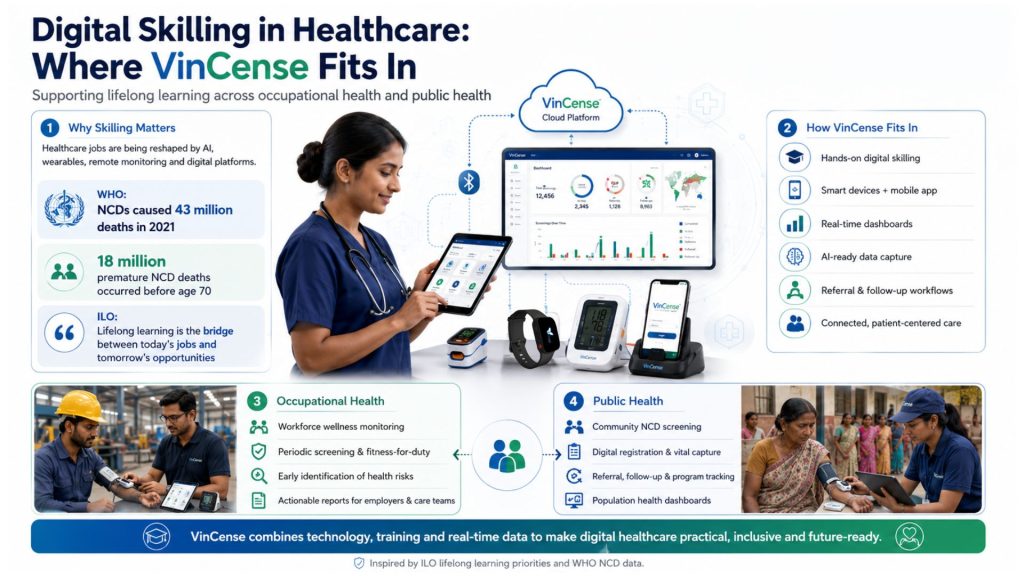
WHO’s Global Strategy on Digital Health states that digital health should strengthen health systems through digital technologies and that countries need capabilities and skills to promote, innovate, and scale digital health solutions. This directly supports the need for practical digital skilling among healthcare workers. VinCense fits into this requirement by acting as both a digital health solution and a hands-on skilling platform. It trains users through real-world workflows: device handling, mobile application usage, Bluetooth data capture, cloud syncing, dashboard monitoring, report generation, referral tracking, and follow-up management. For frontline workers, it builds confidence in digital screening. For doctors and nurses, it supports real-time patient review and decision-making. For occupational health teams, it improves workforce wellness monitoring. For public health administrators, it enables program-level monitoring, data analysis, and evidence-based planning. This makes VinCense highly relevant in the current healthcare transformation. It does not only introduce technology; it helps healthcare workers learn, adapt, and apply technology in practical care settings. Alignment with ILO, WHO recommendations As highlighted by the International Labour Organization (ILO), lifelong learning must become a central pillar of workforce development in a rapidly changing world. This is especially true in healthcare, where AI, wearables, remote monitoring, and digital platforms are reshaping how care is delivered. The World Health Organization (WHO) has also emphasized the importance of digital health in strengthening health systems and improving access to care. With the rising burden of NCDs and the growing need for early detection, digital skilling is essential across both public health and occupational health. VinCense fits into this future by acting as both a digital health solution and a practical skilling platform. It empowers healthcare workers to use technology confidently, supports doctors with real-time data, helps occupational health teams monitor workforce wellness, enables public health administrators to track programs effectively, and supports patients with timely, preventive, and connected care. In line with the ILO’s focus on lifelong learning and the WHO’s vision for digitally enabled health systems, VinCense helps ensure that healthcare digital transformation becomes inclusive, practical, workforce-ready, and patient-centered.