What is ESG?
ESG is an acronym that stands for Environmental, Social, and Governance. These are the three most important factors to consider when assessing an investment’s long-term viability and ethical effect. ESG criteria are increasingly being used by socially conscious investors to analyze possible investments. The ESG investing strategy is based on the belief that environmental, social, and governance factors may influence corporate success and market returns. When considering such a plan, investors should analyze a variety of ESG aspects, indicators, and data. These considerations often include, among other things, industry-specific challenges such as carbon footprint, climate change, labor management, corporate governance, privacy, and political beliefs.
Investors Focus on ESG – New Trend
A closer look at the three pillars
Consulting firms and investors can assess a range of criteria or particular concerns within each pillar to determine how an individual business performs.
a) Environmental pillar:
The main question here is how a company’s behavior affects or impacts the environment.
To be sure, this is a rather broad group. Climate change, pollution, and waste are all important factors, but there are a number of additional challenges that might affect a company’s long-term financial health and existence. These are some examples:
- Its dependence on or use of fossil fuels
- Its use or control of water and other resources
- Levels of pollution
- Changes in the climate
- Hazardous substances and their disposal
- Carbon footprint and usage of renewable energy
Investors might also examine environmental opportunities such as switching to alternative energy or fuel sources.
- Using procedures that save resources and reduce pollution
- Adopting a carbon-neutral stance or reducing one’s carbon impact
- Growing plants, for example, contributes to environmental rehabilitation.
- Adopting steps to promote clean energy
- When looking at organisations in the chemical, energy, and utility industries, environmental factors become very important
b) The Social Pillar: In this pillar, we analyse the impact of a company’s social behaviour. These also include:
- Employment equality and gender diversity
- Product safety concerns and liability
- Employee health and safety
- Training and development
- Animal testing
- Stance on various physical and mental health-related issues, such as topics such as drug abuse, gambling and reproductive choice
- Supply chain transparency
- Human rights
- Access to Healthcare
- Corporate Social Responsibility
c) Governance Pillar: The governance pillar relates to a company’s internal operations, or its corporate behaviour. Other government considerations that may be taken into account while evaluating a company include:
- Compensation of employees and board executives
- Board and company diversity
- Tax strategy and accounting standards
- Bribery and corruption
- Fraud
- Ethics and values
- Transparency and anti-corruption
- Shareholder rights
Solutions for ESG Reporting
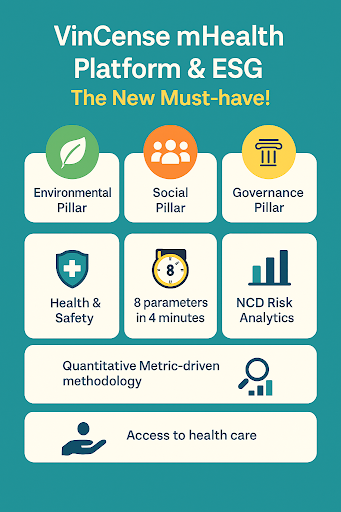
Considering that ESG Reporting has been made mandatory for the top 1000 listed companies in India by SEBI in the form of Business Responsibility and Sustainability Report (BRSR), and that quantitative metrics are a key part of it, enterprises are keen on solutions towards it. VinCense mHealth Platform enables the same for the social pillar for the categories of:
- Occupational Health & Safety
- Healthcare-oriented Corporate Social Responsibility